| Quick Answer
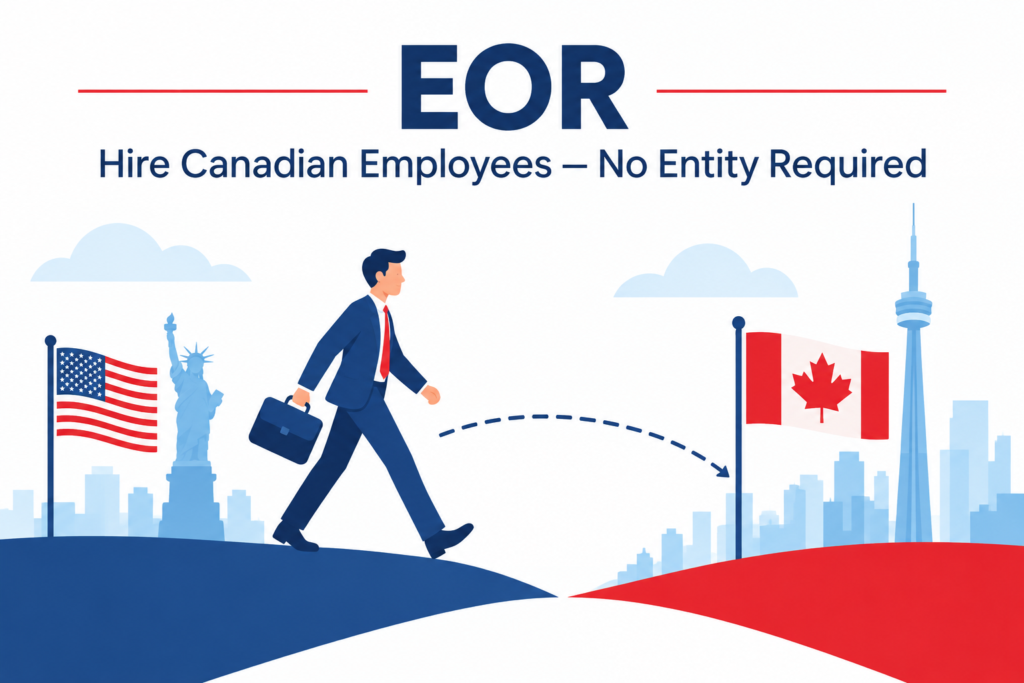
No. US companies can legally hire Canadian employees without establishing a Canadian corporation, branch office, or legal entity, by using a Canadian Employer of Record (EOR). The EOR is already registered in Canada and becomes the legal employer of your Canadian employees, managing all CRA payroll remittances, provincial employment law compliance, and HR documentation while you direct the employee’s day-to-day work. |
It is one of the most common misconceptions among US companies expanding into Canada: that you must first incorporate a Canadian subsidiary before you can hire a single Canadian employee. This belief leads to months of delay, significant legal and accounting setup costs, and lost candidates who accepted other offers while the entity was being established.
The reality is more nuanced, and more practical. There are two legal paths to hiring in Canada as a US company. Which one is right for you depends on your timeline, your headcount, and your long-term Canadian strategy.
Key Takeaways
- US companies do not need a Canadian entity to hire Canadian employees, they can use a Canadian Employer of Record instead.
- An EOR becomes the legal employer of your Canadian employees, managing all CRA remittances, provincial employment law compliance, and HR documentation.
- Treating Canadian employees as contractors paid through US payroll creates serious CRA misclassification exposure.
- EOR is best for 1–15 Canadian employees or market testing. Entity establishment is better for 15+ employees or permanent long-term operations.
- Pivotal can onboard your first Canadian employee within 48 hours. No Canadian bank account, CRA registration, or entity incorporation required.
Option 1: Establish a Canadian Legal Entity
Incorporating a Canadian corporation or registering as a foreign corporation in Canada gives your company the legal right to employ Canadian workers directly. This is the right path for companies making a long-term commitment to the Canadian market with 15+ employees.
Entity establishment involves:
- Incorporating under the Canada Business Corporations Act (federal) or the applicable provincial act, or registering as an extra-provincial corporation
- Opening a CRA payroll account (Business Number with RP subaccount)
- Registering with the provincial workers’ compensation board: WSIB in Ontario, WorkSafeBC in BC, WCB-Alberta in Alberta
- Registering for Ontario Employer Health Tax (EHT) if payroll exceeds the annual exemption
- Registering separately with Revenu Québec if you hire in Quebec, plus QPP and QPIP registrations
- Drafting employment contracts compliant with the applicable provincial Employment Standards Act
Timeline: 3 to 6 months. Cost: $15,000 to $50,000+ before the first employee starts. Right for companies hiring 15+ employees with a permanent Canadian strategy.
Option 2: Use a Canadian Employer of Record – No Entity Required
An EOR is a Canadian company that holds all necessary registrations and becomes the legal employer of your Canadian employees on your behalf. How the EOR arrangement works: see Pivotal’s EOR and PEO services
- Your US company engages Pivotal as the Canadian EOR
- Pivotal drafts employment contracts compliant with the applicable provincial Employment Standards Act
- The employee signs with Pivotal as their legal employer in Canada
- Your employee works under your direction and follows your company culture
- Pivotal processes payroll, remits CPP and EI to CRA, withholds and remits provincial income tax, manages workers’ compensation premiums, and files year-end T4s
- You wire payroll funding to Pivotal in USD, Pivotal converts to CAD and deposits directly to your employee’s Canadian bank account
Timeline: 48 hours. No Canadian bank account, CRA registration, or entity incorporation required.
The Risk of Getting This Wrong: Contractor Misclassification
Many US companies attempt to hire Canadian workers by treating them as independent contractors paid through their US payroll system. This appears simpler but creates serious legal exposure.
| The Canada Revenue Agency applies its own multi-factor test to determine whether a worker is an employee or an independent contractor. Factors include control over the work, ownership of tools, financial risk, and opportunity for profit. A worker who is economically dependent on one company and follows that company’s direction is likely an employee under Canadian law, regardless of what the contract says. |
Consequences of misclassification in Canada:
- Back-payment of CPP contributions, EI premiums, income tax withholdings, and employer contributions for the full period of misclassification
- CRA penalties of 3–10% of amounts owing, plus daily compounding interest
- Retroactive entitlement to vacation pay, statutory holiday pay, overtime, and ESA termination notice
- Potential personal liability for company officers for unremitted payroll deductions
Comparing Your Options: Entity vs EOR
| Requirement | Canadian entity | EOR with Pivotal |
| Timeline to first hire | 3–6 months | 48 hours |
| Setup cost | $15,000–$50,000+ | Included in EOR service |
| CRA payroll account | You must register | Pivotal’s existing account |
| Provincial compliance | You manage directly | Pivotal manages on your behalf |
| Payroll currency | Need CAD account | Wire in USD – Pivotal converts |
| Best for | 15+ employees, permanent presence | 1–15 employees, market testing, fast hiring |
| Year-end T4 filing | Your responsibility | Pivotal files on your behalf |
Hiring in Multiple Canadian Provinces
Canadian employment law is provincial. A company with employees in Ontario, BC, and Quebec is subject to three different legislative frameworks simultaneously. An EOR with national coverage manages all of this within a single engagement. For payroll differences by province, see Payroll Management Services
When Should a US Company Establish a Canadian Entity Instead of Using an EOR?
Consider incorporating when:
- You are hiring 15 or more Canadian employees and the per-employee EOR fee exceeds amortized entity setup costs
- You need to sign Canadian commercial contracts in your own company name
- You require Canadian trade names, GST/HST registration, or Canadian business licensing
- You are pursuing Canadian government procurement requiring a registered entity
- Your investors or board require a Canadian subsidiary for corporate governance
Many companies transition from EOR to a PEO co-employment structure once they incorporate. Read: When Do You Switch to a PEO in Canada? [will add link once the blog is approved and published]
FAQs
Can we pay a Canadian employee through our US payroll?
No. Canadian employees require Canadian payroll with CPP and EI deductions, provincial income tax withholding, and CRA remittances. Your US payroll system is not configured for this and does not connect to the CRA. A Canadian EOR processes Canadian payroll correctly on your behalf.
Does using an EOR in Canada create a permanent establishment for US tax purposes?
This is a question for your US tax advisor. In many cases, using an EOR can help a US company avoid creating a Canadian permanent establishment because the EOR, not the US company, is the legal employer. However, the specific facts of your arrangement matter and you should obtain a formal opinion from a cross-border tax specialist.
How many Canadian employees can we have through an EOR?
There is no legal limit. The practical consideration is cost, EOR fees are typically per employee per month. As headcount grows, the economics may shift in favour of incorporating a Canadian entity and transitioning to a PEO. Pivotal can model both structures against your headcount and growth plan.