| Quick Answer
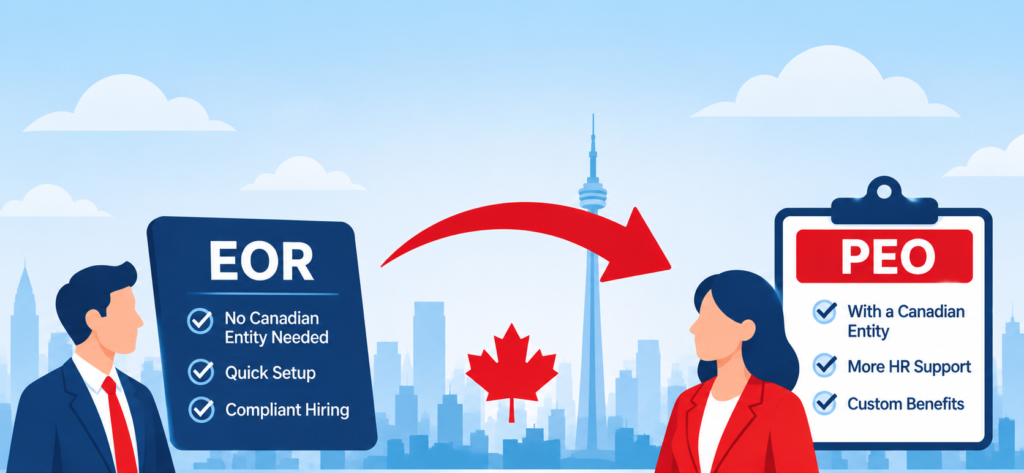
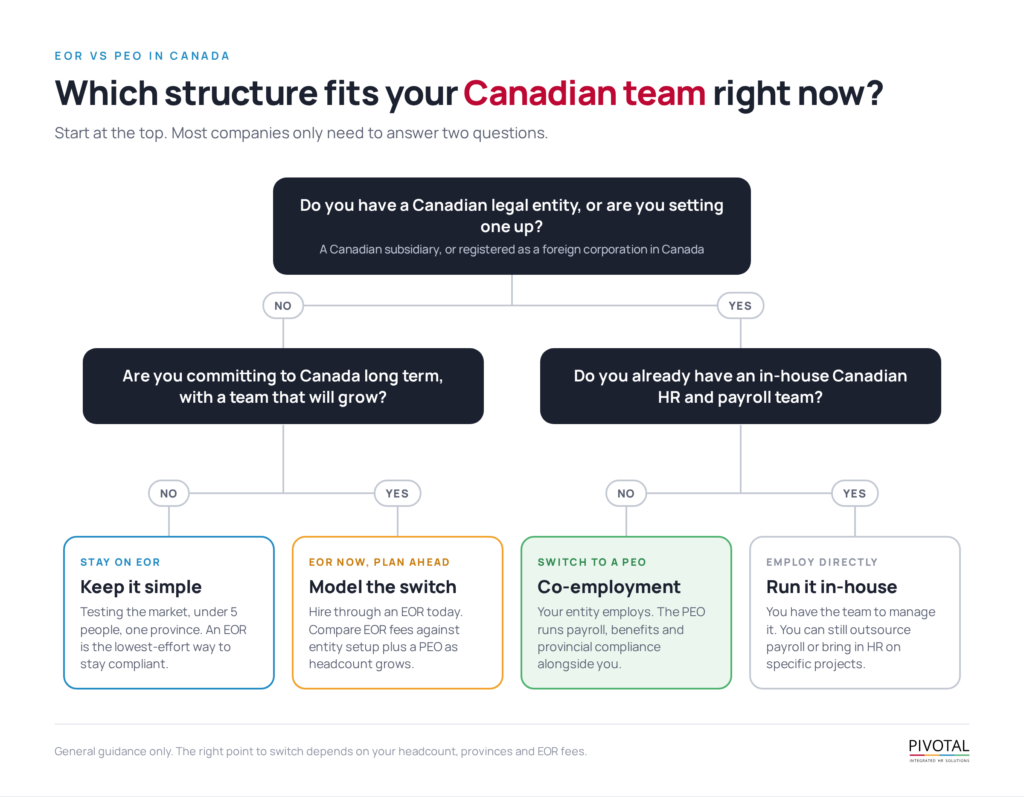
You switch to a PEO in Canada when your company already has, or is ready to establish, a Canadian legal entity, and you need outsourced HR, payroll, and compliance support from a co-employer. If you have no Canadian entity, an EOR is the right structure. If you have registered in Canada and want ongoing HR and employment management without building an internal HR team, a PEO is the transition point. |
Most international companies that hire in Canada start with an Employer of Record. It’s fast, compliant, and requires no Canadian infrastructure. The EOR becomes the legal employer, managing payroll, provincial employment law, CRA remittances, and HR documentation while the client company directs the employee’s daily work.
But an EOR is not a permanent structure for every business. As a company’s Canadian operations mature, the EOR arrangement may become the wrong fit, and a Professional Employer Organization becomes the right one. Knowing when that transition happens is a decision that affects your legal structure, your employees, and your compliance obligations.
Key Takeaways
- You switch to a PEO when you have, or are establishing, a Canadian legal entity and need outsourced HR and payroll without building an internal Canadian HR team.
- EOR is right when you have no Canadian entity and need to hire quickly. PEO is right when your entity exists, and you need ongoing co-employment HR support.
- The five most common triggers: entity establishment, headcount growth, benefits customization, global HR integration, and increasing compliance complexity.
- The EOR-to-PEO transition involves employment contract transfers, benefits re-enrollment, CRA account changes, and provincial workers’ compensation registration, all managed in compliance with provincial employment law.
- Employee seniority does not reset under Canadian employment law when the employer changes.
5 Signs It’s Time to Switch from EOR to PEO in Canada
The following circumstances signal a PEO has become the right structure for your Canadian operations.
1. You Have Incorporated, or Are Ready To – a Canadian Legal Entity
An EOR exists specifically because you don’t have a Canadian entity. The moment you incorporate a Canadian subsidiary or register as a foreign corporation in Canada, the foundational reason for an EOR no longer applies. You now have the legal right to employ Canadian workers directly, but you may not yet have the HR infrastructure to do so compliantly.
A PEO steps into that gap. As your co-employer, the PEO manages payroll, provincial employment standards compliance, group benefits administration, and HR management, while your Canadian entity holds the direct employment relationship. This is the most common trigger for an EOR-to-PEO transition.
2. Your Canadian Headcount Has Grown Beyond What an EOR Model Suits
EOR arrangements are most efficient for companies with a small number of Canadian employees, typically 1 to 15. As headcount grows, the per-employee cost structure of an EOR may become less favourable than establishing a Canadian entity and using a PEO for ongoing HR and payroll support.
There is no universal employee count that triggers the switch. The right threshold depends on the EOR’s per-employee fee, the cost of Canadian entity establishment, and the ongoing HR complexity of your Canadian operations. Pivotal can model both structures against your actual headcount and growth trajectory. See the full comparison: EOR and PEO Services
3. Your Employees Are Asking for Benefits an EOR Package Cannot Deliver
EOR providers offer standard group benefits. As your Canadian team grows and becomes more senior, employees may expect custom drug plans, flexible health spending accounts, executive tiers, or equity participation. A PEO co-employment model allows you to design a benefits program that reflects your employer brand, administered by the PEO. Pivotal’s group benefits service includes fully managed ASO models, insured plans, and custom benefit structures not available through a standard EOR arrangement.
4. You Need to Integrate Canadian HR into Your Global People Operations
Under an EOR, the legal employer of your Canadian employees is the EOR, not your company. This creates a structural separation that can complicate global HR integration: performance management systems, equity plans, HRIS platforms, and global headcount reporting may all require workarounds. A PEO co-employment structure allows your company to be the co-employer of record, so Canadian employees can be integrated into your global HRIS, equity plans, and performance frameworks more cleanly.
5. Compliance Complexity Has Outgrown the EOR Structure
As a Canadian operation matures, employees in multiple provinces, complex leave situations, or government contracting, the standardized compliance framework of an EOR may not be sufficient. A PEO with a dedicated HR team provides the depth of compliance support a growing Canadian operation requires. Pivotal’s HR management service provides on-site or off-site certified HR professionals managing every aspect of your Canadian employment obligations.
For a complete breakdown of both structures, read: EOR vs PEO in Canada: Which Is Right for Your Business?
What Does the EOR-to-PEO Transition Actually Involve?
Switching from an EOR to a PEO is a formal restructuring event, not a simple administrative change. The steps typically involved:
- Canadian entity establishment: Incorporate a Canadian subsidiary or register as a foreign corporation and open a CRA payroll account.
- Employment contract transfer: Employees are issued new contracts under the Canadian entity referencing the PEO as co-employer. This must comply with the applicable provincial ESA, simply novating an EOR contract is not sufficient.
- Benefits re-enrollment: Group benefits under the EOR are terminated and new plans under the PEO structure are implemented with no gap in coverage.
- Payroll account transition: CRA remittances transition from the EOR’s account to the PEO’s payroll infrastructure. Both accounts must be properly managed during changeover.
- Workers’ compensation registration: WSIB (Ontario), WorkSafeBC (BC), or WCB-Alberta registration is established under the Canadian entity if not already in place.
| Under Canadian provincial employment law, a change in legal employer is a material change to the employment relationship and must be communicated to employees in advance, documented in writing, and handled in compliance with the applicable Employment Standards Act. Getting this step wrong creates constructive dismissal exposure. Pivotal project-manages the entire transition. |
When Should You Stay on an EOR Rather Than Switching?
Not every Canadian operation reaches the PEO threshold. Staying on an EOR is likely right when:
- You have fewer than 5 Canadian employees with no near-term plans to grow significantly
- You are testing the Canadian market and have not committed to a permanent presence
- The cost and administrative complexity of incorporating a Canadian entity outweighs the operational benefit
- You operate in one province only with straightforward HR needs
FAQs
Can I switch from EOR to PEO without telling my employees?
No. A change in the legal employer is a material change to the employment relationship and must be disclosed. Under most provincial employment standards acts, a change in legal employer requires a new employment contract. Failing to do this correctly creates constructive dismissal exposure.
How long does an EOR-to-PEO transition take?
Typically 4 to 8 weeks once entity setup is complete. Variable factors include CRA payroll account registration timelines, benefits plan setup and enrollment, and the complexity of existing employment contracts that need to be novated.
What happens to employee seniority when we switch?
Seniority is preserved. Under Canadian employment law, a change of employer does not reset an employee’s service length for the purpose of termination notice, vacation entitlement, or other seniority-dependent rights. Pivotal coordinates the full transition to ensure continuity.
| Ready to Discuss Whether a PEO Is Right for Your Canadian Operations?
Pivotal has been helping companies structure their Canadian employment since 1981. Book a free consultation with a senior HR advisor. |