Professional Employer Organizations (PEOs) and In-House HR both offer paths to managing a workforce, but for Canadian businesses, the choice depends on scale and strategy. A PEO typically offers superior cost-efficiency, enterprise-level benefits, and automated compliance for SMBs (10–100 employees). Conversely, In-House HR provides deeper cultural integration for large enterprises or firms requiring hyper-niche internal oversight.
Key Takeaways
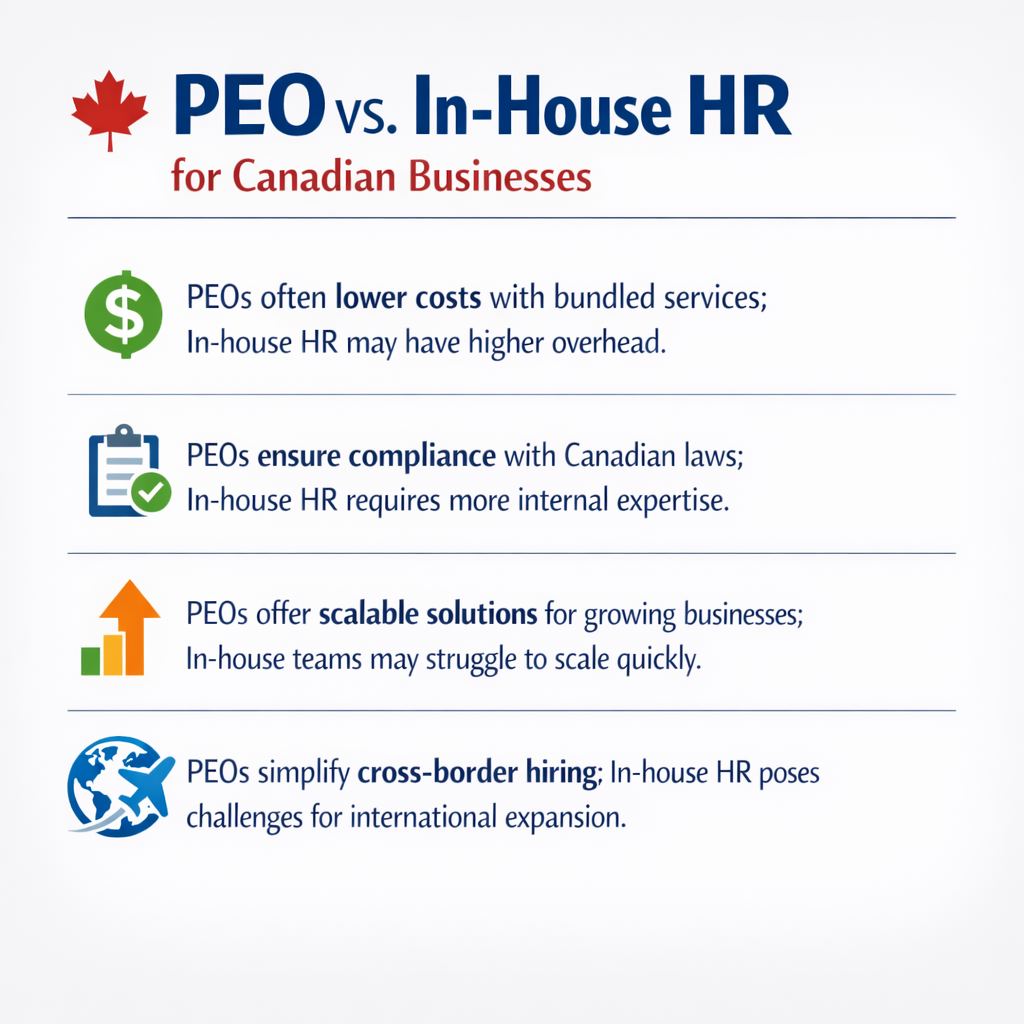
- PEO vs. In-House HR: Canadian businesses must choose between a Professional Employer Organization (PEO) for cost-efficiency, scalability, and compliance support, or an in-house HR team for deeper cultural integration and internal oversight.
- Cost Implications: In-house HR comes with high total costs, salary, benefits, tech subscriptions, and compliance risks, while PEOs offer predictable monthly fees and shared risk.
- Compliance Advantage: PEOs provide a “Compliance Shield,” proactively managing payroll, remittances, WSIB/WCB claims, and Canadian labor law requirements.
- Benefits & Scalability: PEOs grant small and mid-sized businesses access to enterprise-level health benefits and scalable HR services without the overhead of full-time staff.
- Cross-Border Hiring Made Simple: U.S. companies can hire Canadians seamlessly via PEO/EOR solutions, avoiding entity setup and currency conversion issues while remaining legally compliant.
PEO vs. In-House HR: The Definitive Guide for Canadian Business Growth
In the current Canadian economic landscape, the traditional “hire an HR manager” reflex is being challenged. As provincial labor laws become more complex and the “war for talent” intensifies, business owners must decide: do you want to build an HR department, or do you want to grow your business?
Understanding the Core Difference: Co-Employment vs. Traditional Hiring
The primary distinction lies in the legal and operational structure.
- The Canadian PEO Context: Unlike the statutory “co-employment” framework often cited in the US, a PEO in Canada operates through a service agreement where the PEO manages the administrative and legal burdens – payroll, remittances, and compliance, while you retain direction over the employee’s daily work.
- In-House HR: This is a traditional employment model where you hire a full-time professional to manage your HR Management needs. While this offers high “cultural” control, it places 100% of the legal and administrative risk on your shoulders.
The Hidden Costs of In-House HR
While a salary of $85,000 to $110,000 for an HR Manager might seem straightforward, the total cost of ownership (TCO) is much higher:
- Direct Costs: Beyond salary, you must factor in CPP/EI remittances, health benefits, and annual bonuses.
- The Tech Burden: To operate effectively, an internal team needs a modern HRIS, Payroll Management software, and recruitment tools. These subscriptions can easily add $5,000–$15,000 annually.
- The “Compliance Tax”: As of 2026, staying compliant with evolving standards (like Ontario’s “As of Right” framework or new AI ethics guidelines) requires constant legal consultation. An internal HR person often lacks the bandwidth to be a legal expert, a recruiter, and a payroll specialist simultaneously.
Why Canadian SMBs are Pivoting to PEOs
For many growing firms, a PEO acts as a “Force Multiplier.”
- Buying Power: By pooling thousands of employees, a PEO like Pivotal can access enterprise-level health and dental rates that a 20-person company could never get on its own.
- Scalability: You can scale from 10 to 100 employees without your HR costs scaling linearly. You pay for the service you use, not a fixed executive salary.
- Risk Mitigation: From WSIB/WCB claims to complex terminations, a PEO provides a “Compliance Shield,” ensuring your business isn’t derailed by a single legal mistake.
Comparison Table: PEO vs. In-House HR at a Glance
| Feature | In-House HR | Pivotal PEO Solutions |
| Average Cost | High (Salary + Benefits + Tech) | Scalable (Predictable monthly fee) |
| Compliance Risk | 100% on Business | Shared & Proactively Managed |
| Benefits Access | Standard Small Group Rates | Enterprise-Level “Big Corp” Rates |
| Tech Stack | You buy and manage | Included Integrated Platforms |
| US/Cross-Border | High Complexity/Entity Required | Seamless via PEO/EOR Services |
The Cross-Border Advantage: Hiring Canadians from the U.S.
For American companies, the Canadian talent pool is a goldmine of high-skill professionals, often at a significant cost advantage due to the USD/CAD exchange rate. However, the “North of the Border” compliance landscape is radically different from the US.
- No “At-Will” Employment: US companies are often blindsided by Canadian termination laws and mandatory notice periods.
- The EOR Solution for US Firms: Pivotal acts as your Canadian legal entity. We handle Payroll Management in CAD, manage CPP/EI remittances, and provide provincial-specific contracts so you can hire a developer in Vancouver or a sales lead in Toronto without ever opening a Canadian bank account.
- Funds in USD: We accept funding in USD, removing the headache of currency conversion for your finance team.
The Verdict: Which is Right for You?
- Choose In-House HR if: You have 150+ employees and require a constant on-site presence for complex internal culture.
- Choose a PEO if: You are a growing SMB (10-100 employees) or a U.S. company looking to hire in Canada without the cost of a local entity.
Ready to Stop Managing Paperwork and Start Managing People? Don’t let HR administration stall your growth. Whether you need a full PEO solution or a simple EOR bridge to the US, Pivotal Solutions has over 40 years of expertise in the Canadian market.
Get Your FREE Quote Today or Contact Our HR Specialists to see how we can streamline your business.
FAQs
Is a PEO legal in Canada?
Yes. It is a well-established model that allows businesses to delegate legal employer functions (payroll, taxes, insurance) to specialists while maintaining the functional relationship with their team.
Does a PEO replace my HR Manager?
No. It often empowers them. By stripping away the “grunt work” of Payroll Management, your HR lead can focus on strategy and culture.
What is the ROI of using a PEO for a Canadian company?
Businesses using PEOs typically grow 7-9% faster and see a significant reduction in HR overhead, often saving 20-30% in administrative costs in the first year.