
Quick Answer
US employers hiring in Canada must remit CPP, EI, and income tax to the CRA, comply with province-specific employment standards, and avoid worker misclassification. Most US companies use a Canadian Employer of Record (EOR) to handle all payroll compliance without needing a Canadian legal entity.
Why US Employers Must Understand Canadian Payroll and Tax Compliance
Hiring in Canada from the United States seems straightforward on the surface it’s a neighbouring country, a shared language (in most provinces), and a deeply integrated business culture. But when it comes to payroll and tax compliance, Canada operates under a distinct set of federal and provincial rules that catch many US employers off guard.
Misclassifying employees, failing to remit to the Canada Revenue Agency (CRA) on time, or using US-style employment contracts for Canadian hires can result in significant financial penalties, audit risk, and even personal liability for company officers. Understanding the rules before your first Canadian hire is essential.
This guide walks US employers through the key payroll and tax compliance obligations that apply when hiring employees in Canada.
The First Question: Do You Need a Canadian Legal Entity?
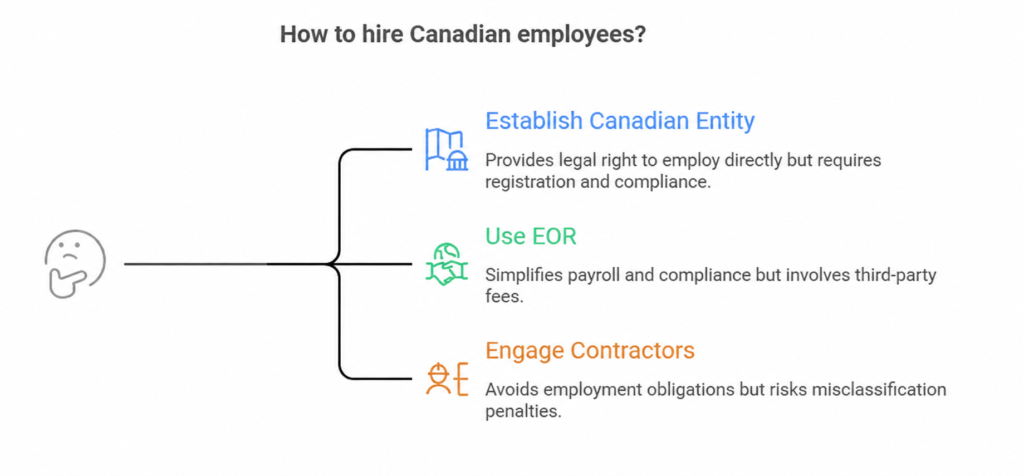
Before discussing payroll mechanics, US companies must address a foundational question: are you hiring Canadian employees as a foreign employer, or will you establish a Canadian legal entity?
Option 1 – Establish a Canadian entity: Incorporating a Canadian subsidiary or registering as a foreign corporation in Canada gives you the legal right to directly employ Canadian workers. You will need to register for payroll accounts with the CRA, provincial workers’ compensation boards (e.g., WSIB in Ontario), and potentially provincial health taxes.
Option 2 – Use an Employer of Record (EOR): Many US companies choose to hire Canadian workers through a Canadian EOR and PEO solution that acts as the legal employer, handling all payroll compliance, CRA remittances, and provincial obligations on your behalf. This eliminates the need to incorporate in Canada and gets you hiring in days rather than months.
Option 3 – Engage independent contractors: Paying Canadian workers as contractors avoids employment obligations but only if the relationship genuinely qualifies as self-employment under CRA guidelines. Misclassification is heavily scrutinized and carries back-taxes, penalties, and interest.
Read more about the risks of worker classification in our series on whether your contract worker is really your employee.
Canadian Payroll: Core Statutory Deductions US Employers Must Know
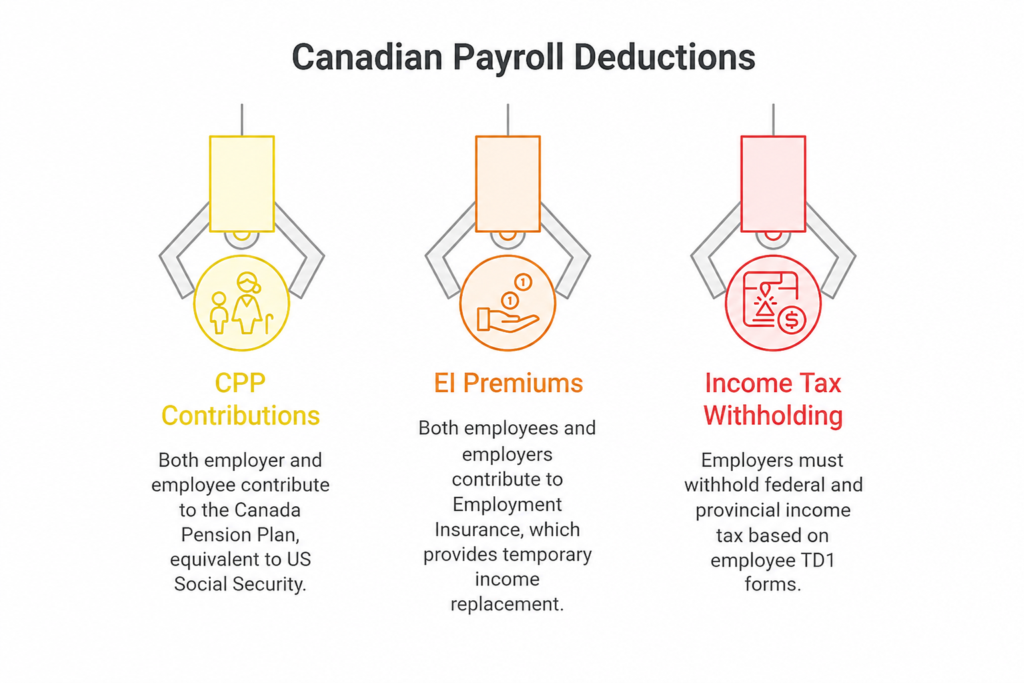
Every Canadian employer or EOR acting on behalf of a US employer must deduct and remit three core amounts from every employee’s paycheque:
- Canada Pension Plan (CPP) Contributions
The CPP is Canada’s national retirement savings program, equivalent in concept to US Social Security. Both employer and employee contribute a percentage of the employee’s pensionable earnings, up to an annual maximum.
As of the current contribution year, CPP rates apply to earnings between the basic exemption amount and the Year’s Maximum Pensionable Earnings (YMPE). Quebec operates its own parallel program the Quebec Pension Plan (QPP) with separate rates and remittances.
Accurate CPP deduction and timely remittance to the CRA is a non-negotiable compliance requirement. Pivotal’s payroll management team monitors annual rate changes so clients never miss an update.
-
Employment Insurance (EI) Premiums
Employment Insurance provides temporary income replacement for Canadians who lose their jobs through no fault of their own, go on parental leave, or experience certain other qualifying events. Both employees and employers contribute to EI, with employers paying a premium rate that is 1.4 times the employee rate.
US employers are sometimes surprised to learn that Canadian parental and maternity leaves are far more generous than US equivalents and that EI plays a central role in funding them. This affects benefit planning as well as payroll processing. Learn about planning for maternity leave and what employers are obligated to provide.
-
Federal and Provincial Income Tax Withholding
Canada uses a progressive income tax system at both the federal and provincial levels. Employers must withhold the correct amount from each paycheque based on the employee’s TD1 forms (federal and provincial), which declare personal tax credits.
Provincial income tax rates and brackets vary significantly across Canada’s ten provinces and three territories. A worker in Ontario faces a different provincial tax rate than one in Alberta (which has no provincial sales tax and a flat provincial income tax structure) or British Columbia.
The CRA’s T4 slip (equivalent to the US W-2) must be issued to employees and filed with the CRA annually, summarizing employment income and deductions.
Payroll Remittance to the CRA: Timing and Frequency
US employers who are new to Canadian payroll often underestimate how strictly the CRA enforces remittance deadlines. The frequency of payroll remittances depends on your average monthly withholding amount:
- Regular remitters – Remit by the 15th of the month following payroll
- Quarterly remitters (new employers or those with small withholdings) – Remit quarterly
- Accelerated remitters – Larger employers must remit within 3 or 10 days of payroll, depending on thresholds
Late or missed remittances trigger penalties starting at 3% and escalating to 10% or more for repeated non-compliance, plus daily compound interest. The CRA also holds company directors personally liable for unremitted payroll deductions in many circumstances.
This is one of the primary reasons US companies choose to work with a Canadian payroll management service rather than attempting to manage CRA remittances independently.
Reviewing the CRA’s most common audit adjustments is a useful exercise for any US company onboarding its first Canadian employee.
Provincial Employment Standards: It’s Not Just Federal Law
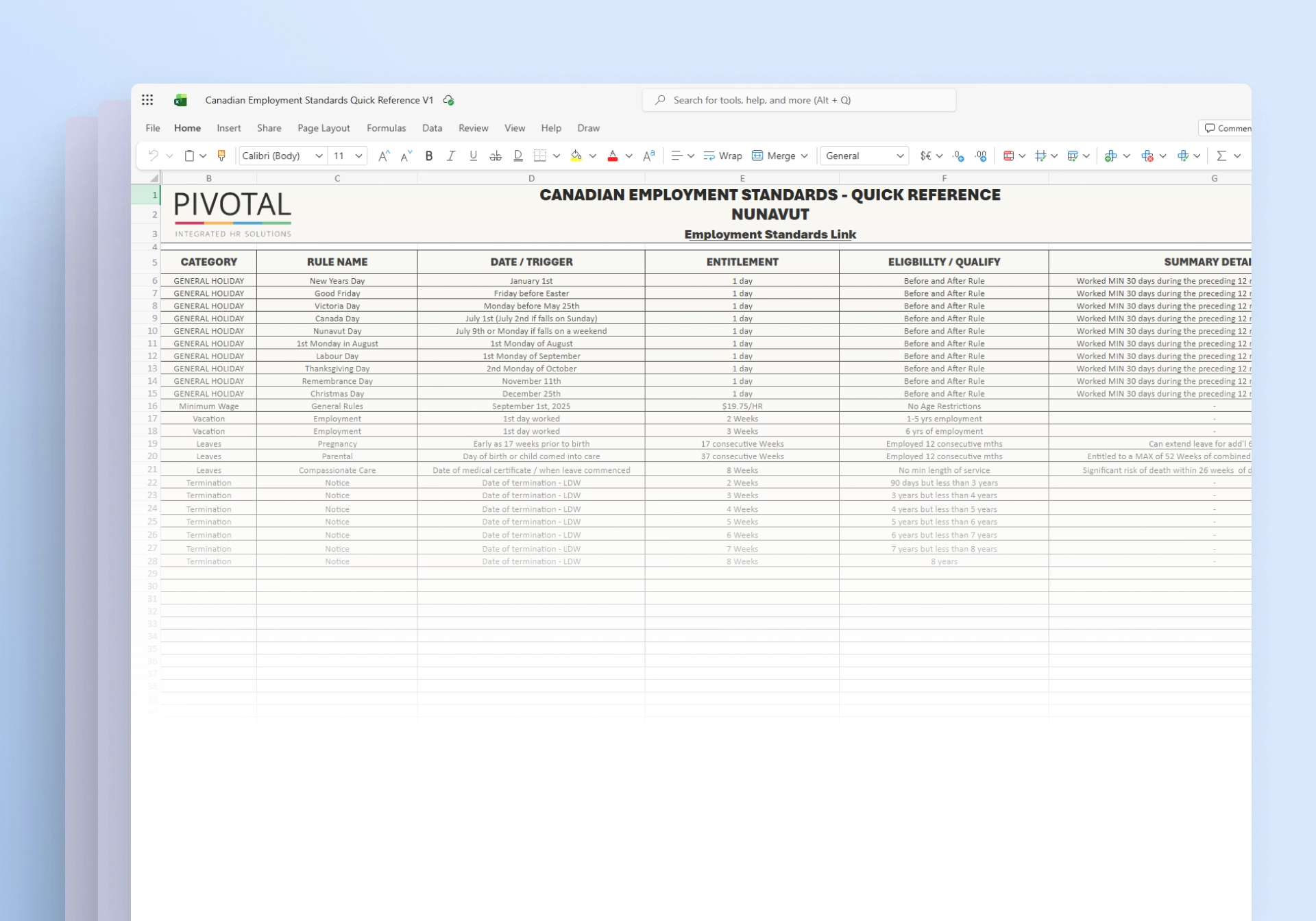
Unlike the US, where federal employment law (FLSA, FMLA, etc.) provides a national baseline, Canada’s employment standards are primarily provincial. Each province sets its own rules for:
- Minimum wage – Rates differ by province and are updated regularly
- Overtime thresholds – Some provinces calculate overtime daily; others weekly
- Vacation pay – Typically a percentage of gross earnings, with minimum entitlements increasing with years of service
- Public holidays – Each province has its own list of Canadian statutory holidays and holiday pay rules
- Termination notice and severance – Provincial minimum notice requirements apply, but Canadian common law can impose significantly longer reasonable notice periods, especially for longer-tenured employees. This is explored in depth in our article on wrongful dismissal claims in Canada.
- Protected leaves of absence – Including maternity, parental, compassionate care, family responsibility, and more. Review Ontario’s protected leave provisions as a starting point.
US employers hiring across multiple Canadian provinces must track and comply with the standards of each province where an employee works not simply the province where the company is headquartered.
Workers’ Compensation in Canada: WSIB and Provincial Boards
Workers’ compensation in Canada is administered provincially. In Ontario, the Workplace Safety and Insurance Board (WSIB) covers most employees, and employers are required to register and pay premiums based on industry classification and payroll.
US employers who fail to register with the relevant provincial workers’ compensation board face premium assessments, penalties, and potential personal liability. Understanding WSIB WorkWell audits and their financial impact is important for companies hiring in Ontario. Our article on claims management and WSIB NEER statements provides further guidance.
The Canada-US Tax Treaty and Permanent Establishment Risk
US companies hiring Canadian employees must also consider whether their activities in Canada create a permanent establishment (PE) for corporate income tax purposes under the Canada-US Tax Treaty. If a PE is triggered, the US company may be subject to Canadian corporate income tax on profits attributable to Canadian operations.
Factors that can trigger PE include:
- Having a fixed place of business in Canada
- Having employees with authority to bind contracts in Canada
- Providing services in Canada beyond a threshold number of days
This is a critical planning point for US companies in the early stages of Canadian expansion. While an EOR arrangement can help manage employee-related compliance, tax treaty analysis should be conducted with a qualified cross-border tax advisor.
For companies considering global payroll solutions that span both Canada and other countries, these treaty considerations multiply quickly.
Employment Contracts for Canadian Workers: Don’t Use Your US Template
A common and costly mistake US employers make is using their standard US employment agreement for Canadian hires simply swapping in a Canadian city. Canadian employment law is fundamentally different, and a poorly drafted contract can:
- Fail to cap common law notice entitlements at the statutory minimum (exposing you to multi-month or multi-year severance)
- Violate provincial employment standards by including provisions that fall below minimum standards (which are automatically void and replaced by statute)
- Create ambiguity around overtime, vacation, and bonus entitlements
Canadian employment agreements should be reviewed by someone with specific knowledge of Canadian employment law and the province where the employee will work. Our article on how employers can turn verbal agreements into written contracts underscores why written, province-specific agreements are essential.
Pivotal’s HR management services include employment contract drafting and review as part of a compliant onboarding process.
Payroll Outsourcing for US Companies Hiring in Canada
Given the complexity of Canadian payroll compliance — multiple statutory deductions, provincial variation, CRA remittance deadlines, workers’ compensation, and employment standards most US companies benefit significantly from working with a Canadian payroll outsourcing partner.
The right payroll management service will:
- Set up and manage CRA payroll accounts on your behalf
- Calculate and remit CPP, EI, and income tax deductions accurately and on time
- Issue T4 slips at year-end
- Stay current on rate changes, legislative updates, and provincial compliance requirements
- Integrate with your existing HR and time-tracking systems
For companies that also need a legal employer in Canada, Pivotal’s EOR solution through Employ Borderless combines legal employer status with full payroll compliance the complete package for US companies entering the Canadian market.
Conclusion
Hiring in Canada from the United States is a significant opportunity access to a bilingual, highly educated talent pool, a stable regulatory environment, and geographic proximity to major US markets. But payroll and tax compliance is not an area where improvisation pays off.
Whether you choose to incorporate in Canada, work through an EOR, or engage a PEO, having the right HR and payroll infrastructure in place from the very first hire protects your business, your employees, and your reputation.
Pivotal Integrated HR Solutions has been supporting Canadian businesses and US companies expanding into Canada for over two decades. Our payroll management, HR management, and EOR/PEO solutions are purpose-built for this exact challenge.
Request a FREE quote or speak with one of our HR experts to get started.
Frequently Asked Questions:
Does a US company need to register with the CRA to hire Canadian employees?
Yes, if you are directly employing Canadian residents, you must register for a business number and a payroll program account with the Canada Revenue Agency. You will also need to register with the relevant provincial workers’ compensation board. If you use a Canadian EOR, the EOR holds these registrations on your behalf. Pivotal’s payroll management services can guide you through this process.
What payroll taxes does a US employer owe on Canadian employees?
As an employer, you are responsible for remitting the employer’s share of CPP contributions (matching the employee’s contribution) and 1.4 times the employee’s EI premium, along with the income tax you have withheld from the employee’s paycheque. These are sent to the CRA according to your remittance frequency. Additionally, workers’ compensation premiums are owed to the relevant provincial board based on payroll and industry.
Can a US company pay Canadian employees in US dollars?
You can pay Canadian employees in USD if both parties agree, but the employment contract should specify the currency. However, for the purposes of CRA remittances, statutory deductions must be calculated on the Canadian dollar equivalent of wages. Most employment arrangements with Canadian residents default to Canadian dollar payroll to simplify compliance and avoid currency fluctuation issues.
What is the penalty for late payroll remittances to the CRA?
The CRA imposes penalties of 3% to 10% of the amount owing for late remittances, depending on how late the payment is and whether it is a repeated failure. Directors of corporations can be held personally liable for unremitted payroll source deductions. Interest compounds daily on outstanding balances. This makes accurate, timely remittance one of the most critical elements of Canadian payroll compliance.
How does Canadian parental leave affect payroll for US employers?
Canadian employees are entitled to maternity and parental leave under federal and provincial legislation far longer than US FMLA entitlements. During these leaves, employees may receive EI benefits through the government, but employers must continue certain obligations (e.g., maintaining benefits coverage where required). Employment Insurance premiums paid through payroll fund this system. US employers should plan for these leaves and ensure their employment policies reflect Canadian entitlements. See our guide on planning for maternity leave for more detail.
What is the risk of misclassifying a Canadian worker as an independent contractor?
The risk is significant. The CRA applies a multi-factor test to determine whether a worker is truly self-employed or is actually an employee. If the CRA reclassifies a contractor as an employee, the payer becomes liable for all unremitted CPP contributions, EI premiums, and income tax withholding plus interest and penalties going back to the start of the engagement. Company directors can face personal liability. Review our two-part series on whether your contract worker is really your employee before making any classification decisions.