
As the calendar year draws to a close, Canadian employers face a critical window for payroll and HR compliance. Missing deadlines, miscalculating contributions, or overlooking legislative changes can result in costly penalties and audit headaches.
At Pivotal Solutions, we help businesses across Canada navigate payroll compliance and HR administration. Whether you’re managing payroll in Ontario, British Columbia, Alberta, Quebec, or across multiple provinces, this guide covers everything you need for a smooth year-end close.
Critical Year-End Filing Deadlines
The T4 Statement of Remuneration Paid is the cornerstone of year-end payroll reporting. Every employer must issue T4 slips to employees and file with the Canada Revenue Agency (CRA) by February 28, 2025. Your T4 slips must include employment income, CPP/QPP contributions, EI premiums, income tax deducted, taxable benefits, and pensionable and insurable earnings. The same deadline applies to T4A slips, which report payments made to contractors and self-employed individuals.
Employers with employees in Quebec must also file RL-1 slips (Relevé 1) with Revenu Québec by February 28, 2025. Quebec employers face additional complexity including Quebec Pension Plan (QPP) contributions, Quebec Parental Insurance Plan (QPIP) premiums, and provincial income tax deductions.
The CRA imposes penalties for late T4 filing ranging from $100 for one to five slips up to $2,500 for over five hundred slips. These penalties can double for repeated failures. Pivotal Solutions recommends beginning T4 preparation no later than mid-January to allow adequate time for reconciliation.
CPP Enhancement Changes for 2025
The Canada Pension Plan enhancement continues to evolve. CPP2, introduced in 2024, requires additional contributions on earnings above the Year’s Maximum Pensionable Earnings (YMPE) up to the Year’s Additional Maximum Pensionable Earnings (YAMPE).
For 2025, the standard CPP contribution rate is 5.95% for both employees and employers. The CPP2 contribution rate is 4% for both parties on earnings between the YMPE and YAMPE thresholds. Employers must calculate both standard CPP and CPP2 contributions for higher-earning employees.
Ensure your payroll software handles the two-tier contribution structure and communicates clearly with higher-earning employees who will see increased deductions. Pivotal Solutions recommends reviewing payroll system settings early in January. Errors in CPP contributions are among the most common year-end audit findings.
Minimum Wage Updates Across Canada
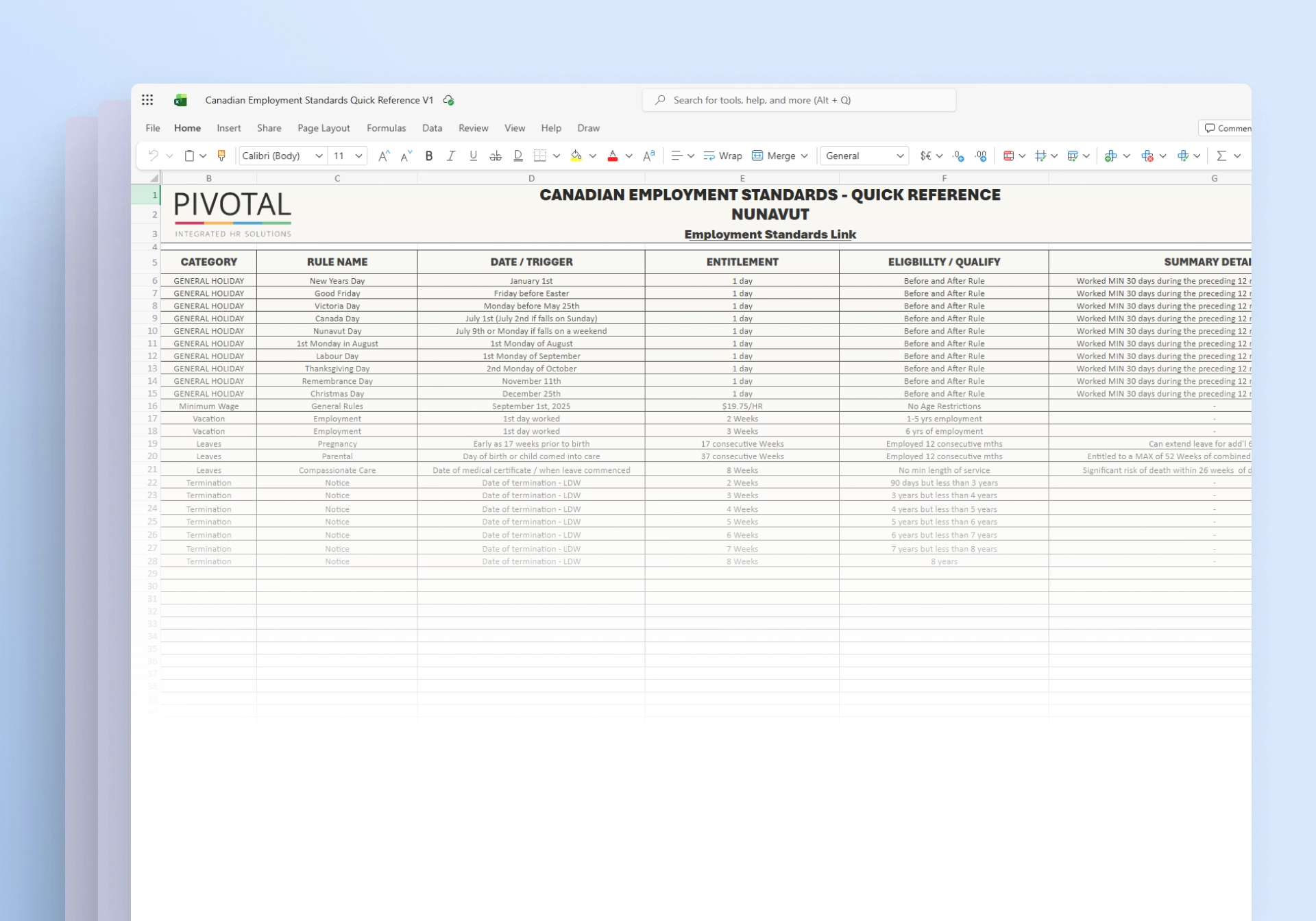
Minimum wage rates vary by province and change frequently. Ontario’s current minimum wage is $17.20 per hour as of October 1, 2024. British Columbia’s minimum wage is $17.40 per hour as of June 1, 2024. Alberta’s minimum wage remains at $15.00 per hour with no scheduled increases. Quebec’s minimum wage is $15.75 per hour as of May 1, 2024. Employers should verify current rates for all provinces where they have employees.
Holiday Pay and Vacation Pay Requirements: Year-end is an ideal time to audit your holiday pay and vacation pay practices.
Holiday Pay Ontario: Holiday pay Ontario requirements are governed by the Employment Standards Act. Ontario employees are entitled to public holiday pay equal to total regular wages earned plus vacation pay in the four work weeks before the holiday, divided by 20. Many employers find using a holiday pay calculator helpful for ensuring accurate calculations, particularly for employees with variable schedules.
Vacation Pay Across Canada: Vacation pay requirements vary by province. In Ontario, employees earn a minimum of 4% vacation pay on gross wages, increasing to 6% after five years of service. British Columbia and Alberta follow similar structures. Quebec requires 4% for employees with less than three years of continuous service and 6% thereafter.
Before year-end, reconcile vacation pay accruals and verify all vacation pay owing has been properly accrued. A holiday pay calculator can streamline these calculations. Pivotal Solutions recommends auditing vacation pay balances in December to resolve discrepancies before T4 preparation.
Provincial Legislative Changes
Ontario’s Working for Workers Acts require employers with 25 or more employees to have written policies on electronic monitoring and disconnecting from work. Non-compete agreements are generally prohibited. Job postings must disclose expected compensation and cannot require Canadian experience.
BC provides 5 paid sick days annually under the Employment Standards Act. New pay transparency requirements mean employers must include expected pay ranges in job postings.
Alberta employers should focus on reviewing general holiday pay calculations, overtime averaging agreements, and termination notice compliance.
Year-End Taxable Benefit Reporting
The CRA requires employers to include certain benefits on employees’ T4 slips. Failure to do so can result in penalties and reassessments.
Gift Cards and Gifts
Gift cards are always taxable regardless of amount. However, employers can provide non-cash gifts up to $500 annually tax-free, plus an additional non-cash long-service award of up to $500 for employees with at least 5 years of service.
Holiday Parties and Social Events
Employer-provided parties are generally not taxable if available to all employees, up to $150 per person for up to 6 events annually. Events exceeding $150 per person or limited to select employees become taxable benefits.
Allowances
Flat-rate car allowances, housing allowances, and general expense allowances are typically taxable. For automobile allowances to be non-taxable, they must be based solely on kilometers driven for business purposes at a reasonable per-kilometer rate.
Other commonly missed taxable benefits include group term life insurance premiums above $25,000 coverage, employer-provided parking, and fitness memberships.
Common Year-End Mistakes to Avoid
Pivotal Solutions sees these mistakes frequently: incorrect CPP/QPP calculations with the new CPP2 structure, missing taxable benefits like gift cards and parking, inaccurate holiday pay and vacation pay calculations, incorrect employee information on T4 slips, and late filing resulting in escalating penalties.
Partner with Pivotal Solutions for Year-End Success
At Pivotal Solutions, we specialize in helping Canadian businesses navigate payroll administration and HR compliance. Our team stays current with legislative changes across all provinces.
We can help with year-end payroll reconciliation, T4/RL-1 preparation, CPP compliance review, holiday pay and vacation pay audits, and multi-provincial payroll compliance.