Running a small and mid-sized business (SMBs) can be rewarding — but it can also be risky; especially when it comes to payroll. Below, we highlight five of the most common payroll mistakes that SMBs make:
Mistake #1: Misclassifying workers
Misclassifying employees as independent contractors (and in some cases vice versa) is a common payroll mistake that SMBs make. According to the CRA, a worker should likely be classified as an employee if the following characteristics are present:
- the worker works exclusively for the organization
- the organization provides tools
- the organization controls duties, whether that control is used or not
- the organization sets working hours
- the worker must perform services
- the organization provides pension, group benefits
- the worker is paid vacation pay
- the organization pays expenses
- the worker paid salary or hourly wage
- the worker reports to organization’s workplace on regular basis
Alternatively, the CRA says that a worker should likely be be classified as an independent contractor if the following characteristics are present:
- the worker may work for other organizations
- the worker provides tools
- the worker decides how the task is completed
- the worker sets own working hours
- the worker may hire someone to complete the job
- the worker does not participate in organization’s benefit plans
- the worker receives no vacation pay and has no restrictions on hours of work, or time off
- the worker pays own expenses
- the worker is paid by the job on predetermined basis
- the worker submits an invoice to organization for payment
- the worker may accept or reject work
In some cases, assessing a worker’s role and responsibilities in light of these characteristics will clearly establish if they must be classified as an employee or independent contractor. However, there are other cases where the determination is ambiguous.
For example, a worker is obliged to provide their services during an organization’s business hours, since they must regularly engage with colleagues (who may or may not be employees/independent contractors). Yet at the same time, the worker has control over how (though not necessarily when) their tasks are completed. In this scenario, the worker’s day-to-day experience is reflected on both lists — which means that a deeper analysis is needed to make the correct determination.
However, many SMBs do not have the in-house resources or expertise to conduct this deeper analysis — or even realize that is it necessary — and consequently they choose the option that is best for their organization (this usually means classifying workers as independent contractors, since there are fewer mandatory employer-related costs, and administration is simpler). What’s more, some workers may, themselves, want to be classified as an independent contractor vs. an employee, since they enjoy certain tax deductions that would otherwise not be available to them.
Ultimately though — and this is a salient point that takes some SMBs by surprise — it does not matter what a worker agrees to either verbally or in writing. What matters are the actual facts. If the CRA determines that a worker should be classified as an employee, then that ruling will prevail. Employers who misclassify an employment relationship, whether deliberately or in error, run the risk of expensive litigation, fines, and reputation damage.
Mistake #2: Missing or inaccurate statutory remittances
For many SMBs, correctly calculating statutory remittances is not a simple task. There are different provincial and federal regulations to follow, and it is also necessary to choose the appropriate remittance calculation formula based on the type of payment being processed (e.g., pay period calculations, annualized bonus tax calculations, or lump sum tax calculations).
Mistake #3: Not properly maintaining records
The CRA requires that employers maintain — and be ready to provide upon request — payroll records for seven years. This data includes all hours worked, payment rates, and the date of every payroll. In addition, each province has its own payroll record-keeping requirements. Lost or incomplete records can lead to major problems and big costs.
Mistake #4: Not calculating and reporting all taxable forms of compensation.
The CRA has a broad definition of compensation that may not necessarily be viewed as such by employers or employees, but nevertheless must be reported (and subsequently subject to income tax). For example, non-salary taxable compensation could include items such as:
- automobiles or other motor vehicles
- board and lodging
- gifts and awards
- group term life insurance policies
- interest-free or low-interest loans
- meals
- security options
- tool reimbursement or allowance
- transit passes
- tuition fees
What’s more, these items have different rules on whether employers must deduct CPP and/or EI, and include or exclude GST/HST. There are also different codes that must be entered on T4 slips. For example, paying an employee automobile and motor vehicle allowances in cash is code 40 (and is not subject GST/HST), while paying an employee automobile and motor vehicle allowances through non-cash methods is code 34 (and is subject to GST/HST).
The takeaway is that for many SMBs, calculating and reporting the total compensation for each employee is complex. Errors and omissions are treated harshly by the CRA, which expects employers to completely know what they are doing when it comes to all aspects of payroll management — or get help if they need it.
Mistake 4: Missing remittance due dates
In Canada, remittance schedules for payroll deductions are based on the average monthly withholding amount (AMWA) of an employer. This is the total of all payroll deductions that were paid to the CRA within a calendar year, and then averaged on a monthly basis. The CRA uses a two-year history of an employer’s AMWA to classify whether it is a new, regular, accelerated, or quarterly remitter:
- New remitters are employers that have never made a remittance payment (typically because they just launched). Payments for each calendar month are due on the 15th of the following month.
- Regular remitters have less than two years of AMWA history, or a two-year history of remittances of $25,000 or less. Payments for each calendar month are due on the 15th of the following month.
- Accelerated remitter (threshold one) have two years of AMWA history between $25,000 and $99,999.99. Payments are due on the 25th day of the month for payroll processed during the first 15 days of that same month. Deductions for payroll processed after the 16th are due by the 10th day of the following month.
- Accelerated remitter (threshold two) have two years of AMWA history greater than $100,000. Payments are no later than the end of the third business day following the week during which the payroll was processed.
- Quarterly remitters have an AMWA of less than $3,000 in the previous two years, or a flawless compliance history with the CRA. Payments are due by April 15th, July 15th, October 15, and January 15th for payroll processed in the previous quarter. Status for eligibility as a quarterly remitter are reviewed annually.
It is very easy for SMBs to get busy and focused on other priorities — such as meeting customer/client orders or dealing with supply chain or cash flow problems — and lose sight of these payroll remittance deadlines (or their applicability/eligibility based on their AMWA and reporting history). This can be very costly. At the current time, the CRA levies the following penalties:
- 3% if the remittance is 1-3 days late
- 5% if the remittance is 4-5 days late
- 7% if the remittance is 6-7 days late
- 10% the remittance is more than 7 days late, or if it never paid
- 20% for repeat failures and violations
Mistake #5: Failing to comply with legislative changes
SMBs need to be aware of, and adhere to, ongoing legislative changes. These include changes to CPP/QPP/EI rates, income tax brackets and rates, various tax changes at the federal and provincial levels, minimum wage rates, statutory holidays, and more.
How to Avoid Costly Payroll Mistakes
The best and most cost-effective way for your SMB to avoid these (and other) costly payroll mistakes is simple: partner with PIVOTAL.
PIVOTAL has decades of experience providing payroll services to SMBs and larger organizations across Canada. We offer five payroll solution options: Full-Service Payroll, Self-Service Payroll, Emergency Coverage, Employer of Record/PEO, and Global Payroll.
Our Full-Service Payroll solution includes:
- Dedicated payroll specialist
- Externally audited under the CSAE 3416
- Reliability and outsourced convenience
- Customizable reporting
- No contract termination fees
Our Self-Service Payroll solution includes:
- Dedicated payroll specialist
- Real-time preview
- Outsource any and all remittances and third-party payments
- Pre-defined timecards
- Customizable reporting
Our Emergency Coverage solution includes:
- Our payroll platform or yours
- Maternity leave and sick leave coverage
- Last-minute coverage
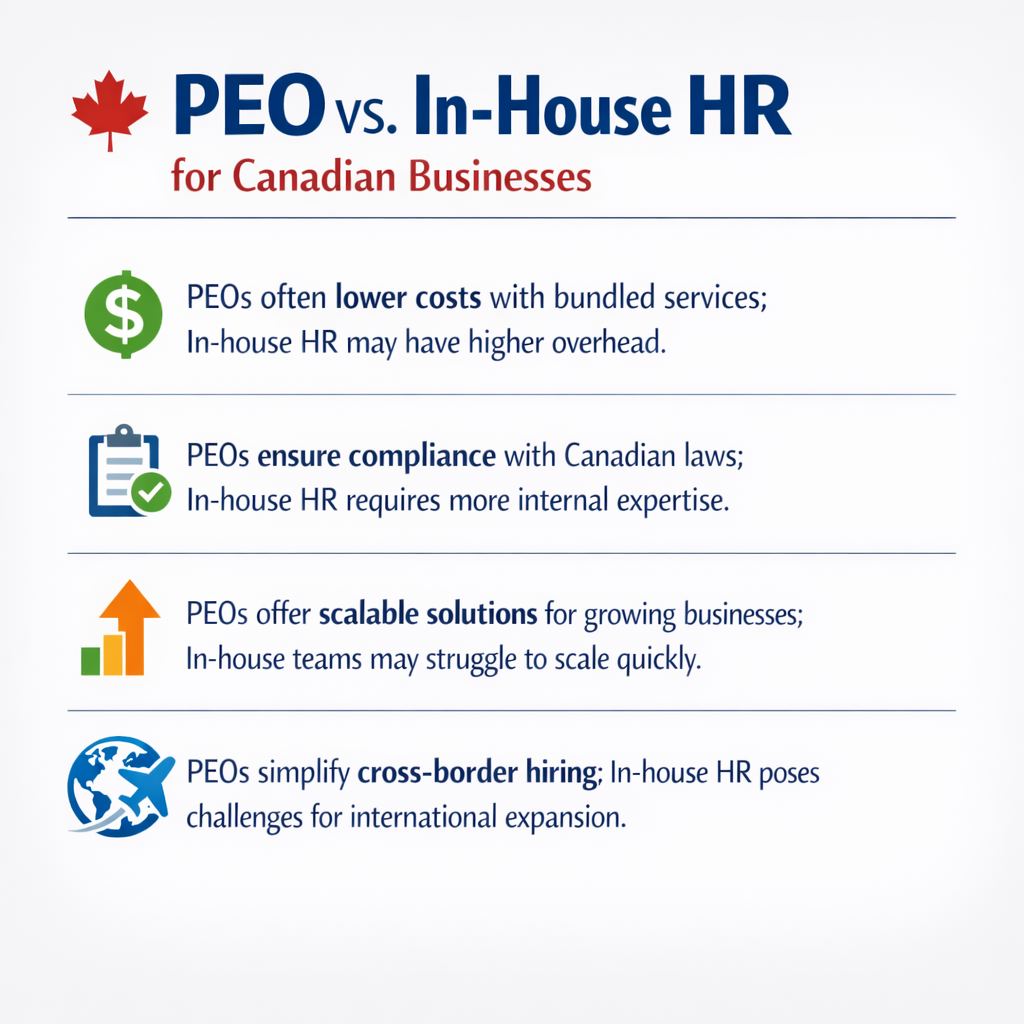
Our Employer of Record/PEO solution includes:
- Full-service employee management
- Payroll management
- Employee benefits
- Dedicated payroll/HR specialist
- No need to register as an employer in Canada
PIVOTAL is also an in-country-provider for several Global Payroll companies, including:
- activpayroll
- Blue Marble
- Immedis